
Gini
In economics, the Gini coefficient (/ˈdʒiːni/ JEE-nee), sometimes called the Gini index or Gini ratio, is a measure of statistical dispersion intended to represent the income inequality or wealth inequality within a nation or any other group of peopleIn the following Gini is a measure of income inequality in various states
| State | Gini | Total Dropout | Primary Dropout |
|---|---|---|---|
| Andhra Pradesh | 0.24 | 63.69 | 31.77 |
| Assam | 0.17 | 74.96 | 51.58 |
| Bihar | 0.17 | 83.06 | 53.37 |
| Gujarat | 0.25 | 59.29 | 35.72 |
| Haryana | 0.31 | 32.48 | 5.04 |
| Karnataka | 0.23 | 59.38 | 16.25 |
| Kerala | 0.29 | 7.15 | 0 |
| Madhya Pradesh | 0.24 | 64.7 | 11.12 |
| Maharashtra | 0.27 | 54.16 | 6.6 |
| Orissa | 0.25 | 64.42 | 42.60 |
| Punjab | 0.26 | 44.06 | 27.42 |
| Rajasthan | 0.2 | 73.87 | 58.92 |
| Tamil Nadu | 0.26 | 55.19 | 1.94 |
| Uttar Pradesh | 0.23 | 43.77 | 21.8 |
| West Bengal | 0.24 | 78.03 | 43.23 |
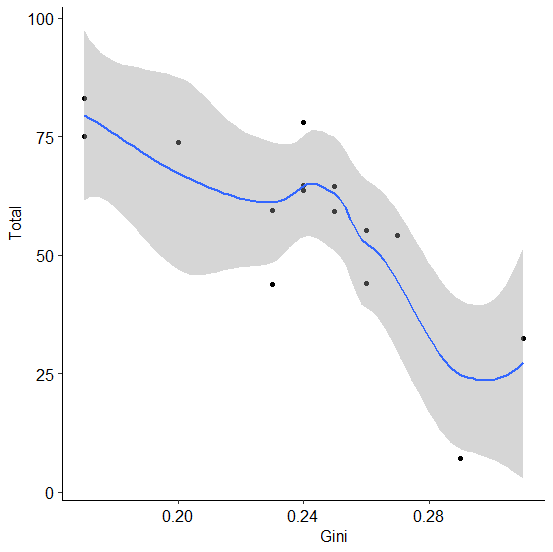
Shows that Total DropOutRates decrease as inequality decreases or Gini is more
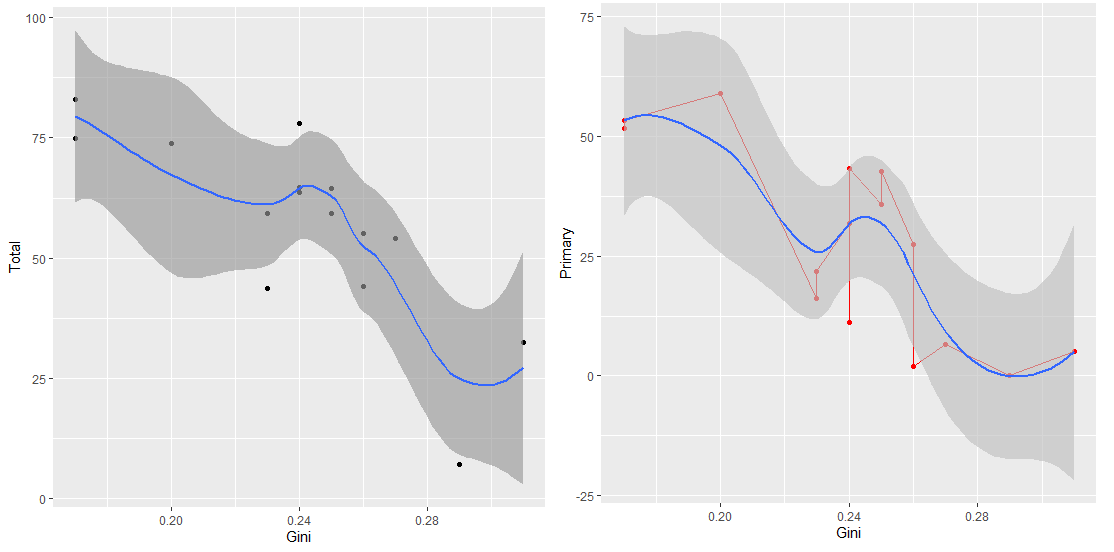 Shows that Both Total DropOutRates and Primary School DropOutRates decrease as inequality decreases or Gini is more
State Level Inequalities in Economic Development (Mridula Goel, Associate Professor of Economics, BITS, Pilani K.K.Birla Goa Campus Goa Campus) for Gini Data
Selected Educational Statistics 2004-05 for DropOut Data
| Privacy Policy | Service Policy | Contact Us | AppWiz Software . All Rights Reserved. |
Powered by w3.css